Cairo: Remembrance of Things Past

party 2

Another season in Cairo after an especially long sojourn back home and I am already missing old friends. I have returned after a fresh wave of departures – the yearly diaspora that is part of life for foreigners here. This round has been especially harsh; it feels like my circle has dissipated overnight. I thought I had taken precautions to maintain my friendships as my relationship with S deepened, but I hadn’t counted on the loss of impetus to make new ones.

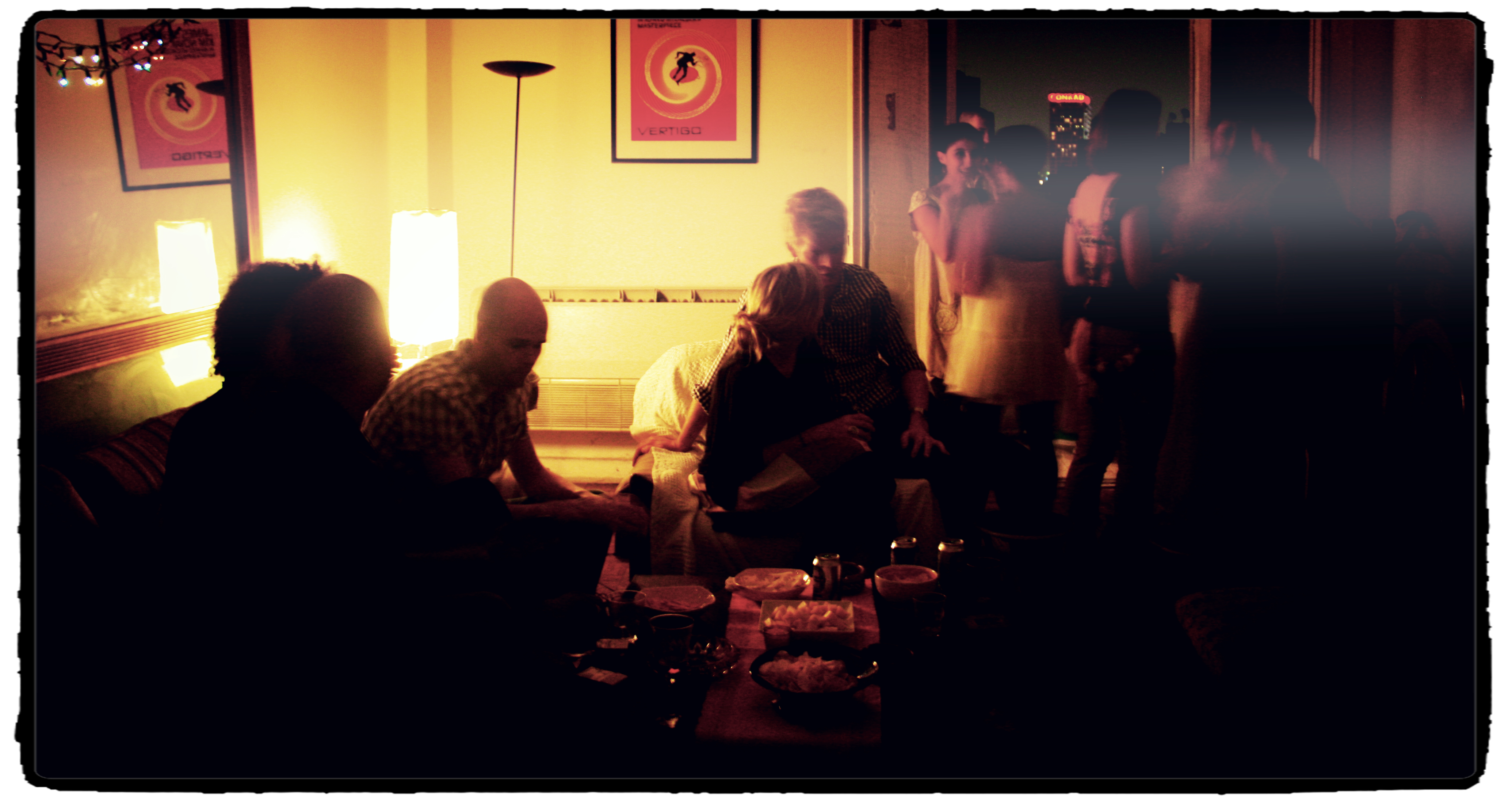
The ghosts of old friends pervade the city. In that home on the corner, I once partied late into the night, as old Egyptian belly dance movies flickered on a wall behind us. On another occasion – it must have been winter – we huddled up on the balcony with our drinks over a makeshift fire, shooting the breeze til dawn and exhaustion crept in. When other friends lived there, I attended sunny barbecues in the walled-off garden – a rarity in this city of grey high-rises – eating mezze and grilled meats and watching piles of empties mount up in the corner.

In that flat just up the road, other friends held sophisticated soirees attended by a lively crowd of diplomats and journalists and activists, as the Nile sparkled beautifully in the distance. In this favourite restaurant – now sadly closed – I met many friends over the years, sometimes for big crowded brunches, at others for intimate one-on-ones over fluffy scrambled eggs and toast. We talked about our relationships, our jobs, the joys and challenges of babies, the choices we had made that had brought us to this place at this moment in time.

At that café overlooking the Nile, I brunched with other friends – long, lazy Lebanese breakfasts with Om Kolthoum providing the soundtrack, punctuated by the sounds of the river, cooled by industrial-sized fans. There were felucca rides too with varied friends – more motorboat than traditional felucca in this stretch of the river – but a chance still to escape the crowded streets. On one memorable occasion, I wandered here with a couple of friends for an early morning felucca after an all-night party, drinking in the silence as the sun crept up.

Just around the corner, in that flat with the huge terrace, were more amazing parties – tables laden with food and drink, a butler, sometimes a DJ – and a whole crowd of people who have now departed. Over the years, I have attended parties and gatherings in almost every street in this upscale neighbourhood and their memories linger in the air – Gatsbyesque reminders that the best always seems to be behind us. I am not sure if it is the city that has changed or me. I suspect we have both grown wearier over time.

In this crowded arts centre many years ago, I saw a stirring oud concert with my love at the time – the man who brought me back to this city after my first visit here. Down that busy main street, I sat with a dear friend for mint tea and shisha, discussing our demons and the difficulties of being students again in our 30s. Here too, I walked down to Tahrir with other friends during the revolution – such as it was – a few years later, sometimes fearful, sometimes in awe of my adopted city. I remember our journey down here towards the square in a big group on the night Mubarak fell.

I am the only one left now.

For such a big city, Cairo expat life can feel remarkably provincial – like being on a university campus, with just a few degrees separating you from everyone else in your narrow, privileged circle, and the same unspoken awareness that time is transitory and real life on pause. I remember the many parties I hosted myself – the revolution party, end-of-curfew party, pre- and post-Ramadan celebrations, birthdays, X’mas and New Year’s shindigs. The vast majority of those who attended – both Egyptian and foreign – have now left, their lives overtaken by new jobs, new destinations, husbands, wives or babies.

There are new people now. I met one the other day – a young American girl of 23 who has been here for a year, breathless in her love for her new life here. I was like that once, I think, but I am weighted down by memories now. Goodbyes are more painful when you are far from home – your friendships more intense, heightened by the knowledge that sooner, rather than later, you will part.

In time they will renew themselves – I have been here long enough to know that. For the moment though, I am in limbo, mired in the past, not quite willing to embrace the future.

It doesn’t matter if you bleed (A blogger’s manifesto)

writing

I am writing again, for the first time in more than a year.

Truth be told, I was a little overwhelmed by the success of the last piece, which was, ironically, about writers’ block and the need to overcome it. It didn’t go viral, but by the modest standards of this blog, it may as well have done. I was touched by the depth and breadth of the responses and determined to answer them all. For a while there, it seemed as if I’d finally broken the block, and something profound had occurred. Somewhere along the way though, that turned. I couldn’t face an empty page anymore.

I’m still not entirely sure why. Days turned into weeks and then into months and I wasn’t producing anything – in fact, I was more reluctant to write than ever before. Perhaps I worried subconsciously about the number of followers I’d gained and how I would follow the last piece, or perhaps my modest success had simply highlighted the futility of the whole thing (I am susceptible to existential malaise at the best of times). I realise that I am one of those people who are more frightened of success than failure. Go figure.

The truth – and one that I don’t think I touched on in that last piece – is that it also takes a certain amount of arrogance to expose your writing to the world, to believe what you’re saying is worth reading. That makes me uncomfortable. I questioned my deeper motives for blogging. My ultimate aim as a writer is to be authentic – to find my voice and remain true to that. Comments I’d happened to read from a number of successful bloggers worried me – that their blogs had become all-consuming and skewed their voices, to the point that they’d lost sight of who they were, as writers and as people.

But to echo my previous piece – to call myself a writer, I must write. To find my voice – an authentic voice – I must write even more. I’m still a perfectionist and I still don’t like a lot of my writing but the more I write, the easier it gets. I’ve subscribed to a few writers’ inspiration sites lately too and it’s reminded me again that the majority of us find it difficult, that first drafts often suck, and that perseverance is all. The alternative is to live in fear and live a life that feels forever unfulfilled.

As Hemingway put it: There is nothing to writing. All you do is sit at a typewriter and bleed.

On coping with writer’s block (or the lies we tell ourselves along the way)

writing 2


I haven’t written in a very long time.

I joined a creative writing class a while ago to help me through my ‘writer’s block’ – can you call yourself a writer if you don’t write? – and I managed to produce a total of 500 words over the entire four-week course. A paltry amount by any standards, though the course itself was brilliant.

One of the suggestions from my fellow writers was to write about why I don’t write. I’ve been thinking a lot about the reasons I don’t write lately so this seemed as good a place to kick off my writing again as any. And also address why I call myself a writer in the first place – a hard sell in the writing void of the last few months.

In my professional life, I have been a public relations consultant, a journalist and now, an editor. Words play a big part in all of these professions, but using words professionally can also sound their death knell (which is why journalists and copywriters in England are often referred to as hacks, and why I struggled during the creative writing course to allow myself to indulge in the sheer poetry and playfulness of language).

Ultimately, I call myself a writer because it’s all I’ve ever wanted to be. My love of writing and books has imprinted itself on every aspect of my life, from a natural affinity and love for bookshops and libraries to the deep and immediate connection I feel with other writers, my tendency to navigate the world verbally rather than visually, and the nagging sense that I am failing in something vital when I don’t write. If you believe, as I do, that everyone has something to offer the world, then this is mine.

But my body of work as a writer at this point in time is pitiful – there’s no other word for it. I’ve journaled, of course – though not regularly enough – and my computer is littered with pieces I’ve started and never finished: scraps of reviews, features, blogs that never developed into anything, ideas for stories/blogs that never materialized.

I’ve joined and started my own writing groups, online and real world, and I’ve probably read every article on how to get writing or why we procrastinate you can imagine. I even dumped my trusty Samsung PC and invested in a gorgeous MacBook Air a couple of years ago so I could lug my computer to cafes more easily and write more. And I still haven’t mastered the art of writing consistently. Or writing at all.


This is what I’ve learned along the way:


1. Writing is hard

Ok – it’s not hard in the way that feeding your kids is when you’re broke, or doing backbreaking manual labour for a pittance, or dealing with a terminal disease, or bereavement, or any of the other terrible tragedies that befall us in life. But it’s hard because, if it’s going to be any good, at some point or another, you’ll be digging deep inside your own personal well for inspiration.

You’ll be foraging for scraps and ideas, and sometimes you’ll be venturing into the darkness – into shadowy places in the recesses of your mind or heart that you’ve kept locked away for a reason. It takes courage to do that – which is why, I think, so much great art springs from misery. When you’re already at the bottom, there’s nowhere else to go but up.


2. Writing is extra hard when you’re a perfectionist

Perfectionism is crippling and something that I believe is particularly crippling for the female of the species. I don’t want to stray into the reasons for that but I do remember being struck at my first newspaper by how much quicker my male colleagues produced copy. For me, it often feels more like giving birth – forgive the analogy – and the labour pains can be excruciating (I apologise in advance to the mums out there). Every word has to be just right and the structure and cadence have to be perfect too, which can make writing both tedious and exhausting – and very, very slow.


3. You’re baring your soul

Especially if you’re writing a personal blog but this applies all round, I think. I still remember the anxiety I felt when my first byline appeared as a journalist. Suddenly hundreds – perhaps even thousands – of people were going to be reading something that I wrote (and if I was lucky and reasonably good at what I did, hadn’t been butchered by a sub having a bad day).

The best analogy I can use is that I felt strangely naked. This was actually for a local newspaper and the best riposte – then and now – to anyone getting precious about their copy is the old British adage that “today’s news is tomorrow’s fish ‘n chips paper.” Though in our digital age, what you write is out there pretty much forever. That’s a helluva load to bear at times.


4. Writing is lonely

This might be the toughest one of all and the reason why so many of us freelance writers, in particular, put it off for as long as possible. The truth is, for many writers, the only thing that gets us moving is a deadline – usually one wielded by a terrifying editor, and/or one that your next check depends on.

Writing for any other reason is a tortuous (see point 1) and deeply lonely process that requires a commitment to sitting at your chosen writing spot by yourself for as long as it takes to produce something. And a blank page staring back at you is, quite frankly, a terrifying thing. This is when watching terrible reality TV/cleaning the house/doing the washing up/catching up on your emails or Facebook/ tidying your wardrobe or performing just about any other mundane chore you’ve been putting off for ages suddenly becomes very appealing.

Combine this with the points that I’ve listed above and it’s a miracle that anything’s produced at all.


5. Writers have the most creative excuses (or, no one rationalises like a writer)

During my times of block – which have been too many to recount – I’ve come up with increasingly desperate strategies to a) either increase my output or b) explain why I’m blocked in the first place. These have ranged from getting rid of my Samsung in favour of a lighter computer (all writers fantasize about increased portability and how it will stimulate their writing) to wanting to move to a desert island or, failing that, to move my desk/adjust my writing area (since the feng shui is clearly wrong or the sun’s shining in the wrong spot), to the necessity for writing companions (hence the numerous writing groups), to subscribing to various writing sites, to reading countless articles on the sources of other writers’ inspiration, in the hope that somehow the magic will rub off.

None of this works. It’s all obfuscation – or, to paraphrase both Nike and Bukowski – real writers just do it.


6. Writers’ egos are fragile      

Writers, by nature, are sensitive folk and particularly vulnerable to criticism and critique, especially if we’re putting ourselves out there on a regular basis. Of course, few people will actually critique you to your face – unless you’ve hit the big time and written a bestseller or gone viral – though again, the Internet’s changed up the game and brought your readership virtually to your desk now.

But I’d hazard a guess that many of us writers fear the judgment of our peers in particular. We are also our own worst critics, especially if you’re also an editor like me. I cast a critical eye on most things I read, including my own work – when I can bear to re-read it at all. The problem is that it’s all entirely subjective anyway which means there’s never going to be a proper consensus on whether something’s good or not. You’ve just got to grin and bear it.


7. Creativity and discipline are mutually exclusive

Now this isn’t strictly true or no great art would ever have been produced but I think you know what I mean. For all of the reasons listed above, and possibly a few others, our tendency is to look at the production of anything ‘artistic’ as a spontaneous process – a cathartic outpouring, if you like. As a culture, we’ve always romanticised the mad genius/tortured artist archetype, something that other artistic souls are particularly susceptible to (I can definitely attest to this). It takes growing up to realize that writing is a craft that requires dedication and practice, and a little discipline in the process will take you an awful long way.


Ultimately, the writer’s paradox is this – you battle your fragile ego and swallow the loneliness and misery and angst of the process because you want to reach out and connect, as EM Forster famously said. Because this is your way of making sense of the world and you’d like to – need to! – share it, in the hope that someone else out there feels the same way too. And because, in some small way, you’re repaying the countless writers, journalists and bloggers who enlivened your world for a moment, or made you think, or moved you to tears or joy or laughter, simply by choosing the right words.

Do I have any advice for any of you struggling with the block right now? This – the only thing I’ve consistently heard and the only thing that really makes sense: Stop making excuses and just do it. If you can inject some discipline into your writing practice, even better. Most of all, just write.

We’re writers – that’s what we do.


15 things I learnt from Facebook


facebook


As an expat and freelance editor and writer working mainly from home, battling procrastination on a daily basis, I’m on Facebook a lot. It’s the virtual equivalent of people watching in a favourite café – with the added benefit that you actually know the people and can interact with their lives. Which can be both a good and a bad thing, depending on my mood – and has also made me especially aware of the things I like and dislike about it. At the risk of sounding like someone who mostly inhabits a sad virtual world instead of the real one, these are some of the things I’ve learnt from Facebook:


1.If citizen journalism is taking over the world, citizen PR, which Facebook pioneered, comes a close second. It’s the perfect opportunity to present your best self to the world – edited highlights only.

2. Which should come with a disclaimer: it can be bad for your health. I can’t count the number of times I’ve depressed myself looking at the perfect, activity-filled lives of my friends – until I realize they’re probably thinking the same of my life.

3. You can never have too many ‘likes.’ A post without likes is rather like seeing someone standing all alone at a party. Liking someone else’s post is also a wonderfully simple way to show you care.

4. The number of friends you have means nothing. I have more than 700. Despite that, I can go a day or two without speaking to a real person. It’s like cable TV – you can have 500 channels and there’s still nothing you feel like watching.

5. There’s a virtual voyeur in all of us. It’s incredible how easy it is to find yourself perusing some random person’s profile in a ‘brief’ break from the job at hand.

6. It’s possible to learn stuff. Good stuff. Interesting/quirky/funny posts that I’d never have come across otherwise (unless I was on Twitter, in which case I’d be completely overwhelmed and vow never to venture online again).

7. It’s also possible to deepen your relationships. Some of my favourite Facebook friends are people I’ve met briefly but really got to appreciate online, when I discovered we shared similar values/senses of humour/political beliefs.

8. Unfortunately, the reverse is also true.

9. Pithy, inspirational quotes are over-rated. I appreciate the sentiment – I’m a sucker for a good Rumi quote myself – but the best ones have done the rounds too often.

10. Humour is definitely subjective.

11. People like good news. And they like to ‘like’ good news. I’ve come to the conclusion that affirming someone else’s good fortune makes us all feel like better human beings. Which also reaffirms my faith in human nature.

12. I get a buzz every time I see the red number – because I have no idea who’s trying to contact me or has just done or said something relevant, and it’s happening in real time. The potential for pleasant (and unpleasant) surprises is infinite.

13. The majority of people want to be nice. I’ve bared my soul on more than a few occasions and I’ve been genuinely touched by the responses I’ve received.

14. It’s addictive –  partly because it taps into our baser instincts:  the need for control, instant gratification, gossip. But it also satisfies a deeper human urge – the need to connect, to find commonality, to share.

15. There’s no such a thing as a typical Facebook user. My friends comprise all ages, nationalities, political beliefs, sexualities, religions and taste levels, which makes my newsfeed a pretty interesting place.


There’s an argument you hear a lot these days that the Internet has increased the quantity, but reduced the quality, of our communications with each other. I’m not sure I buy into that – I think it’s entirely possible to have both, and to deepen your relationships in simple and surprising ways.

Because the older I get, the more I realise how important it is to connect and stay connected to people, and Facebook’s helped me do that in a way that was impossible just five years ago. For that, I’m grateful.

On the challenges of keeping an open heart

When I was much younger, I read an interview with Debra Winger – an actress I adored growing up – talking about a meeting she’d once had with Kathleen Turner, another strong, sensual 1980s heroine who’s sadly fallen off the radar today.

I can’t remember the specifics but Winger said she’d met Turner briefly at a party – or perhaps on a film set – and the latter had been friendly enough, but a little aloof. To paraphrase Winger, she said she got the impression that Turner had made all the friends she wanted in life and wasn’t interested in acquiring any more.

I must have been in my late teens or early twenties at this point and I remember thinking: Why would anyone do that?  There was something very disconcerting about it to me – this idea that you could suddenly reach a point where you’d made all the friends you needed in life and you weren’t interested in reaching out anymore, in meeting new people, in being challenged. It seemed to me to be the ultimate sign of a closed heart.  And a closed heart was exactly what I wanted to avoid.

As I’ve grown older, however, I’ve had two major, but very contradictory, realisations.  The first was a sudden and profound understanding of exactly what E.M. Forster – a writer I read a lot of in my youth – meant when he said ‘Only connect’ – an achingly simple phrase that was only very loosely penetrable to me in my teen years. (That connecting with your fellow human beings, whether by seeking out ‘kindred spirits,’ or by having a brief but uplifting exchange, was actually the very essence of life.) Living as I do here in Cairo, far away from family and friends, those words have often echoed in my head. People can make you miserable, no doubt, but they can also make you blissfully happy.

But running alongside that realization was the slow dawning that age and experience, and perhaps also my life as an expat, had terribly coloured my view of my fellow humans. I realized that I was no longer as willing as I once had been to give everyone a chance. No longer did I repeat to myself fervently that everyone had good and bad points; nor was I willing to be as open as I’d been before. I had better instincts now and I was more willing and able to follow those instincts. To put it another way, as I told friends, I had become smarter, and thus fussier, about who I spent my time with.

Perhaps that, in itself, is no bad thing – it seems to make sense that you should surround yourself with good people, as hundreds of positivity books will tell you.  There is the undeniable fact also that we understand ourselves better as we get older and become more comfortable with who we are, which then influences the choices we make. And yet, it still seems to me a fundamental fallacy, somehow – this idea that age and wisdom make you more discerning about people and your circle will narrow but strengthen as a result.

I think the truth is more prosaic – life and age can harden your heart, and sometimes you never even realize that it’s happening.  An accumulation of hurts, big and small, a multitude of let-downs – as is bound to happen in life – a cacophony of so-called ‘a-ha’ moments (I was an idiot to trust that person/ I was wrong about this one/ this person is going to let me down) and a few rejections move you further and further away from the open-hearted generous soul you once were, or may have aspired to be.

Once upon a time, I chose to trust and to accept that a bruised heart and ego might be an acceptable consequence of that choice, the price I would pay for having an open heart. Somewhere along the line though, I’ve lost that ability, to the extent that my life has now become littered with people who haven’t quite ‘made the grade,’ while the number of people who do make the cut become smaller and smaller.

At the end, it is always a choice. Living like this means a life lived from fear – a fear of rejection and hurt – a life lived from our lower rather than higher selves.  Better, I think, to force open our hearts once again, to live with courage and conviction and love, to remain open to life and to new people and all the challenges they may bring. If the heart is a muscle, as they say, only practice and exposure will strengthen it.

Overprotect it and it will wither away and slowly die.

The End of the Affair


I had my first cigarette at the age of 15. I’m not quite sure how I got my hands on one – perhaps a guest had inadvertently left a pack in our house. I lit it, tried to breathe in, coughed and promptly put it out. I can’t say I enjoyed the experience.

Later, in my first year at university in England, I tried again. This was more than 20 years ago, when smoking, and smokers, was still relatively cool. You could smoke in the majority of public places: on the top deck of buses, on certain carriages in trains, on station platforms, in smoking rooms in offices, in restaurants and bars, of course, and even – which shocks me now – in a cinema. (I still remember puffing away in the gloom of Coventry Odeon though the films I watched escape me).

For a good part of that year, I wasn’t properly smoking. I hadn’t learnt yet how to inhale a cigarette and suck the smoke into your lungs and slowly exhale, without turning red and collapsing into a coughing fit.  Nobody really teaches you how to have your first cigarette – probably because it’s too embarrassing to admit that it is your first cigarette. The fact that I had valiantly – and foolishly – decided to start my smoking life on Marlboro Reds, the crack cocaine of the cigarette world (as it seemed to me then), made my attempts even more painful.

There were many different types of smoker, I discovered. There were the social smokers, perhaps the least loved category – the bisexuals of the smoking world.  Their desire to smoke in the company of others, usually with a drink, would probably have been slightly less irritating if they’d remembered to buy their own cigarettes first.  There were the occasional smokers, who smoked casually and randomly – not dissimilar to the habitual smokers, who smoked because they were used to it and because they could. In Egypt, where I live now, there are many who fall into this category.

And then there were the hardcore smokers, who smoked as if their lives depended on it. Full of nervous energy, twitchy if too much time passed before their next one, sated by the act in the same way that a drug addict calms as he takes his first hit. I see these people now when I return to London, huddled outside bars and restaurants and offices come rain or snow, puffing away like it’s their last cigarette on earth, and it always reminds me of how much the world has changed since I started.

I smoked for many different reasons. I smoked to indulge the angst-ridden teen in me, who’d already decided on a vaguely self-destructive life involving plenty of cigarettes and alcohol, like all the best artists I knew (I was never hardcore enough to go down the drug route). Like many women, I also did it to keep the calories at bay. Instead of having a piece of chocolate, I would have… a cigarette. When my mother lectured me on the dangers of smoking and how I’d lose all my teeth before I was 50 (something that my dentist incidentally also confirmed to me not so long ago), I’d wail, “But would you rather I was fat?”  (This often worked on my mother, who fears fat even more than she fears a dead, toothless daughter.)

And I smoked to quell the restlessness in me, the desire for things I didn’t have and didn’t yet know I wanted, the moments when my romantic soul almost imploded with longing. I smoked when I was angry. I smoked when I was sad – all my relationship break-ups can be characterized by days of sitting under a cloud of smoke, listening to the most mournful music I could find. I smoked when I was happy and out drinking and dancing. I smoked after eating and I smoked after making love.  And I smoked when I was moved by a particular intensity in a song or movie or book – as if somehow the act of smoking, of retreating into myself, would amplify the emotion of that moment. Somehow it always did.

The truth, I discovered, is that you’re never alone with a cigarette in hand.  There is something inherently defensive in the act of smoking, a way of keeping the world at bay, especially when you’re on your own. I can’t remember the number of times I’ve strolled into a bar or cafe around the world on my own and settled down with a glass of wine – or a cup of coffee – and a cigarette, sending out (smoke) signals that I was perfectly comfortable in my own company.

Now – in the West at least – smoking is no longer cool. I grew up on the cusp of that mini-revolution, when images of louche Hollywood stars and legends of cool like Charlie Parker and James Dean, wielding cigarettes the way Clint Eastwood handled his guns, were still just visible on the horizon. I knew that era had died when I went to San Francisco’s fabled House of Blues some years ago and had to pop out every time I wanted a cigarette. The blues without a cigarette is like Egypt without the Pyramids. Christmas pudding without cream. Burton without Taylor. Basically, inconceivable.  And yet, somehow, it happened.

I write all this because I have now joined that mini-revolution – I am no longer a smoker. This – the longest relationship of my life – an act that seemed to define me for years – died two months ago, not with a bang but with a whimper. I’m not entirely sure why – perhaps it was a combination of my dentist’s increasingly dire warnings and an exercise week I participated in, where I realized that my – already horribly limited – ability to run was being crippled by my habit. So it may well have been for the most boring reason of all (for this wannabe rebel anyway): health.

For a while after that marathon exercise week, I continued to reach for a cigarette during my old trigger moments – when I was having a cup of coffee, or my favourite song came on the radio, or when I was particularly stressed by something. But I was doing a Clinton – I’d come full circle and could no longer inhale. And without inhaling, a cigarette is not a particularly pleasant experience.

But this is the thing: I don’t miss it at all. Honest. There isn’t a single day that I’ve woken up craving a cigarette (and I’m a little ashamed to say I often started my day with one). I’ve passed all the tests with flying colours: parties, drinking with friends, a particularly intense movie/music/work/love moment, etc, etc. The relationship had clearly run its course. I am officially no longer a smoker.

And yet. The door is open. There is a pack of my cigarettes on my bookcase should I ever change my mind. I have no hard feelings – my habit now is like an ex I remember fondly, there through all the highs and lows of my life,  always non-judgmental, reliable, dependable – despite a world that increasingly fought to keep us apart. I hope I never turn into one of those ex-smokers who become more self-righteous and sanctimonious than the most earnest of non-smokers.

For many years, I was part of the fraternity, and I don’t regret a single day of it.